Check the scene, then the person
Make sure the area is safe for you. Tap the person and shout. If they do not respond and are not breathing, or are only gasping, treat that as cardiac arrest. Gasping is not normal breathing.
Push hard and fast
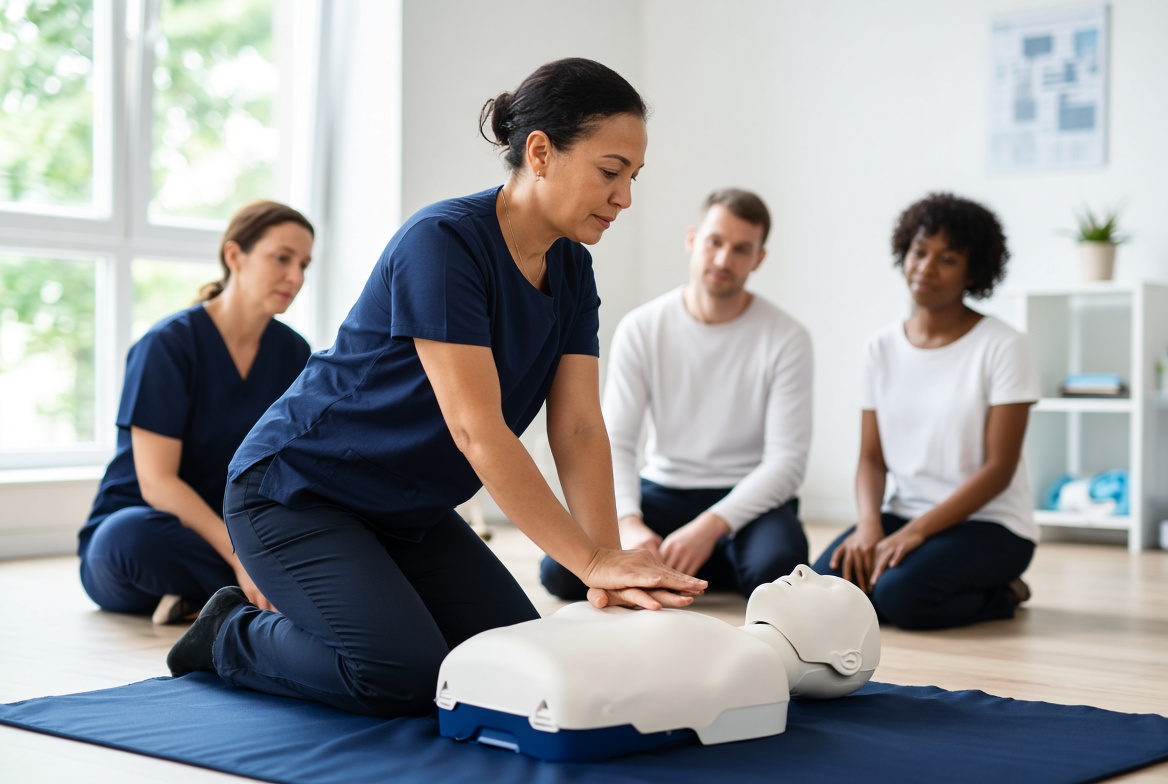
Put the person on a firm, flat surface. Place the heel of one hand on the lower half of the breastbone and the other hand on top. Compress at a rate of 100 to 120 times a minute, at least 2 inches (5 cm) deep, and no more than about 2.4 inches (6 cm). Let the chest come all the way back up. Do not lean on the chest between compressions.
Untrained bystanders should do hands-only CPR: continuous compressions until help or an AED arrives. If you are trained and willing to give breaths, the usual adult ratio without an advanced airway is 30 compressions and 2 breaths. Each breath should last about one second and make the chest rise.
Children and infants are different
Child depth is about one third the chest, roughly 2 inches. Infant depth is about one third the chest, roughly 1.5 inches, with two thumbs encircling the chest or the heel of one hand. One rescuer uses 30:2. Two rescuers for a child or infant use 15:2. If you are alone and the collapse was not witnessed, give about two minutes of CPR before leaving to call, if no phone is with you.
Keep going
Switch compressors about every two minutes if someone else is trained, so quality does not fade. Stop only if the person starts breathing normally, a trained team takes over, or you cannot continue safely.
A written course covers the chain of survival, one- and two-rescuer sequences, and a knowledge exam. It does not replace a hands-on skills session if an employer requires one.